Open any paper.
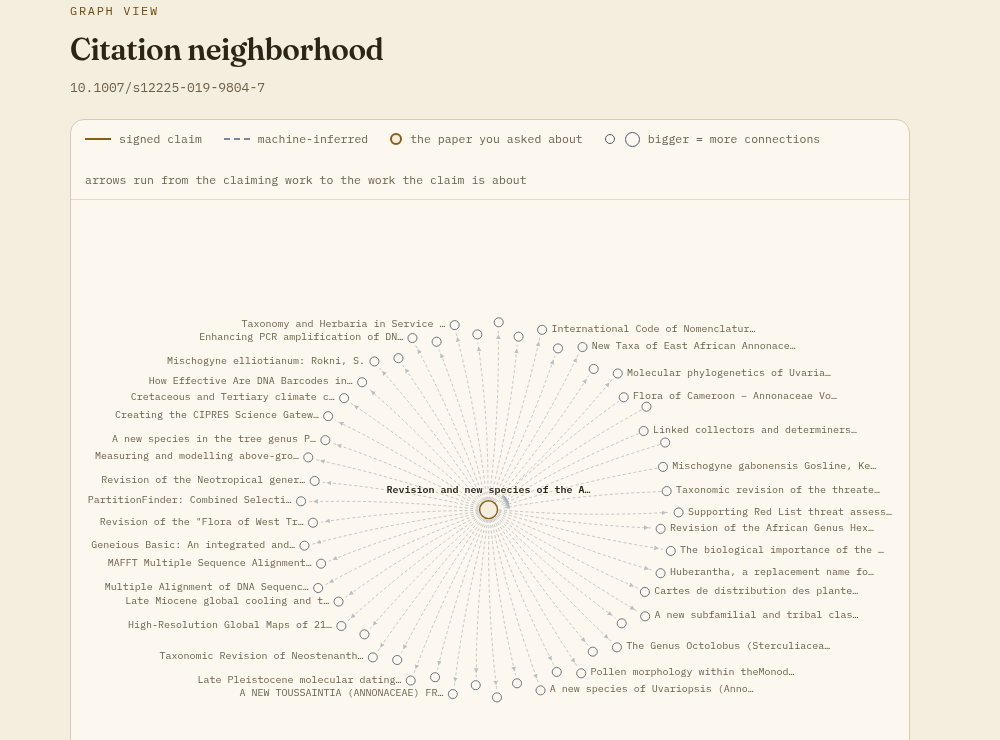
Walk its citations.
Signed claims in gold, machine sweeps in steel, never blended into one number.
The map is free, there’s no account, and the record is CC0. Preprints and Zenodo deposits are in it, not only what the big indexes chose to cover. And when an AI assistant wants to check a citation before it writes one, it queries the same graph without a key.
signed inferred real edges around 10.5281/zenodo.18262424
The map, not the number
Click a node and its neighborhood opens. The literature-mapping apps charge $6 to $12 a month to draw connections, and none of them will tell you whether a citation resolves at all. This one is free and unlimited. Compare it line by line.
Two tiers, never mixed
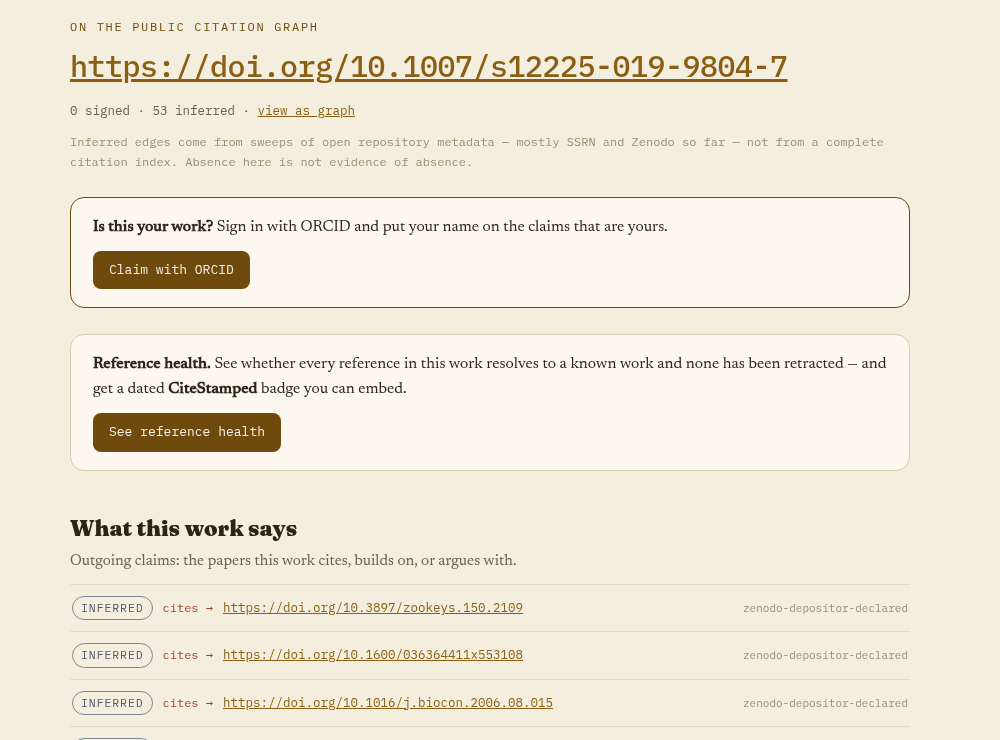
Human-signed claims and machine-harvested edges sit in separate tiers, and every answer tells you which one it came from and who stands behind it. The inferred tier is a labelled snapshot of open scholarly metadata and inherits its errors. That is exactly why it is kept apart.
Indie work is in it
Journals get citation machinery. You don’t have a journal and now you don’t need one. Preprints, Zenodo deposits and datasets get indexed and get a page, and each claim you sign lands on a chained public log nobody can quietly edit.
A place for AI to check
An assistant can ask the live graph before it emits a citation instead of after somebody catches it. No key, no account, signed and inferred labelled separately in every answer. mcp.citestamp.com/mcp
Citations that say what they mean
“Cites” is the least informative word in scholarship: forty entries in a reference list and not one says why. CiteStamp edges carry a type, so a paper can support yours, refute a result, extend a method or use a dataset. Disagree with a result? Refute it, signed, in public. Papers, not people.
And it checks your bibliography
Paste a reference list and every entry gets checked against the open registries: does it resolve to a real work, does the DOI match the paper it claims, has the publisher pulled it since. It runs in your browser, so your draft never leaves your machine. Open the network tab and watch nothing leave. The free watchlist re-checks saved papers daily against the public retraction record in Crossref, which is how a paper you leaned on in March reaches your toolbar when it’s pulled in September.
See it in action
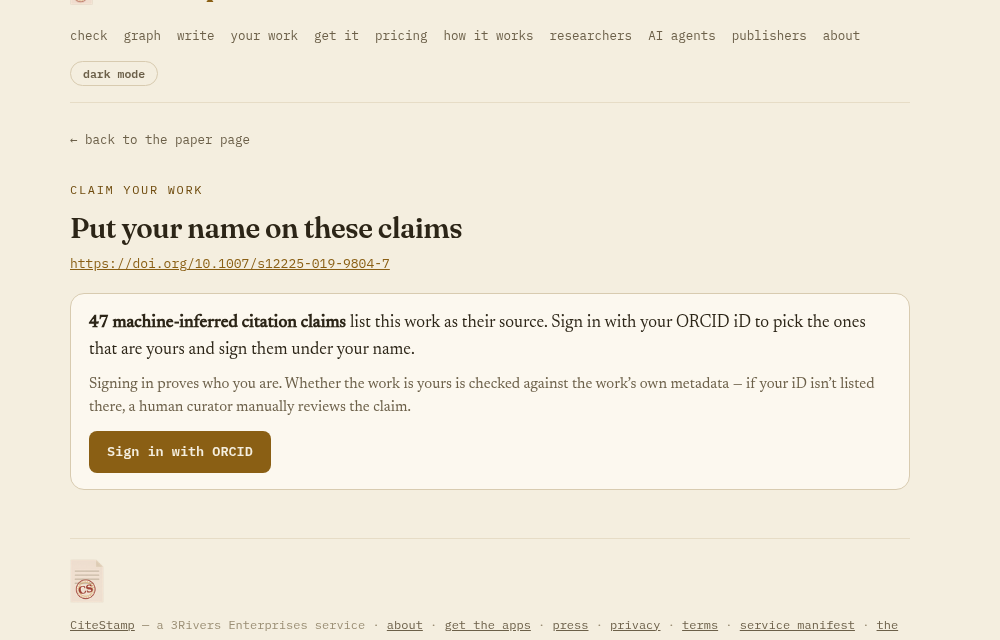
A hallucinated citation caught live, the retraction watchlist, the graph, and every surface it works on. Every product shot is the real thing.
The rules we don’t break
- Signed and machine-inferred never mix. Every answer tells you which kind of edge it is and who stands behind it.
- No verdicts. CiteStamp doesn’t grade claims. It records who put their name on one, and that’s the whole product.
- Papers, not people. You can refute a paper. You can never target a person or an institution. The format makes it impossible, on purpose.
- No coin. The crypto citation graphs make you buy something before your word counts. Here your word is the asset: signed JSON on a public log anyone can fork.
- Nothing of yours is stored. No full text, no abstracts, no personal data, only links between public identifiers, dedicated to the public domain.
Researchers & authors
Claim your papers with ORCID, sign what is yours, and check a reference list before a reviewer collects it. Students too: free means free.
AI agents
Ask the live graph over MCP or REST before you commit a citation. Signed claims and machine sweeps stay labelled and never blended.
Publishers & editors
Screen submissions for references that resolve to nothing, on the same engine as the free checker. Refereeing? Paste the reference list first.
Try it now
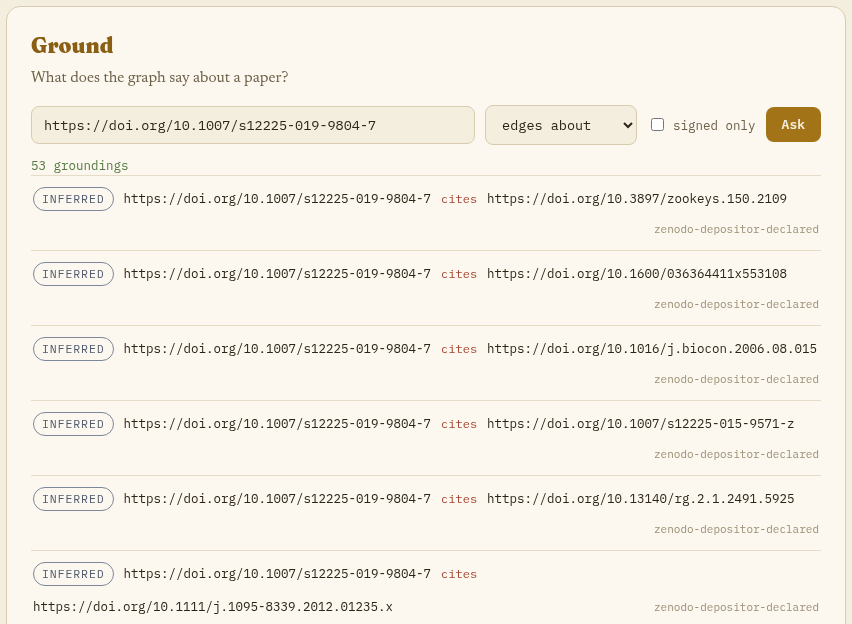
Ask the live graph about any identifier. No account — anonymous asking is limited to 10 a minute. It has its own page at /ask, where an answer is linkable; /ground is what to call from an agent.
Ground
What does the graph say about a paper?
Have a key?
A key raises your limits; a signing key also opens minting below. Connect once and it is saved in this browser — you will not have to paste it again on this machine. It travels only as a header on your own requests, never as a cookie, so no other site can spend it. Treat it like a password: anyone holding your key can use your limits as you. Leaked, lost, or just cautious? Generate a fresh one in your account — that instantly revokes the old one.